Watch our Video
This regularly updated charity fundraising trends report uses Charity Excellence data to look back at fundraising resilience 2020 to 2025 and what future trends might look like into 2026 and beyond.
For what the charity sector and Government could and should do to respond to the ongoing crisis, see our Charity Sector Road Map for Recovery.
Charity Excellence has aggregated all user data (anonymously), since 2018, using its 500+ health check metrics, which are combined into various models.
| Our Charity Sector Data Store is now conservatively estimated to be 1 million data points. Reporting is via 5 Power BI dashboards that are able to track, and dice and slice data in a large variety of ways.
One of the models reported is fundraising resilience, which tracks 83 of these of the 500+ metrics. |
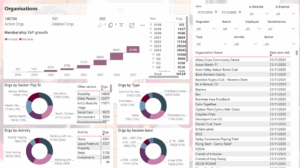 Power BI - Dashboard 5 |
We simply don't have the capacity or influence to fully exploit the huge and growing data set we have. We plan to do so as part of our next generation Charity Excellence 2.0. This will see the existing web sites and underpinning eco system disappear and become part of the new emerging agentic web, delivering not only a far more accessible system but also one that is far more powerful.
The Covid crisis really began to impact in Mar 20, but the data shows sector fundraising falling from late 2019. We're not sure why. We have data from mid 2018 but our community numbers only really surged with Covid, so we're wary about how robust pre-2020 data is.
| What the data shows is that we reached bottom in Apr 20 The dip on the left) and were back to Mar 20 levels by Jul 20.
Fundraising resilience then continued to surge and to far higher levels than before, peaking in Feb 21 (the peak in the middle) before slowly falling back to 2019 levels. |
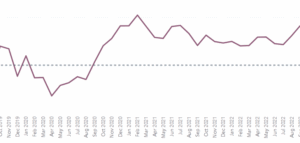 Nov 19 to Sep 22 |
Nobody really knows but in our Covid Lessons learned exercise, we use our grants data and other sources to estimate the Covid funding provided to have been in the region of £5 billion.
| In Aug 22, we used our Covid data to create a predictive model of the coming Cost of Living crisis.
This accurately predicted that it would be much deeper and longer than Covid and we'd hit bottom in Q1 23. Recovery began in Mar 23. This time it took a year for fundraising to return to previous levels; twice as long. |
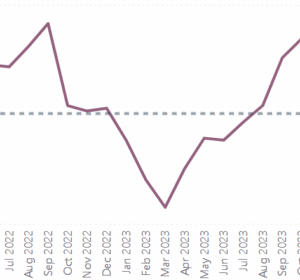 Jul 22 to Sep 23 |
| We'd been raising concerns about Government budget cutting and, having carried out a survey to support our data, in Sep 23 released our £1billion funding cut report.
This predicted a crash, driven by cuts to contracts of mainly larger charities but also in grant funding to small charities, because this is non statutory. |
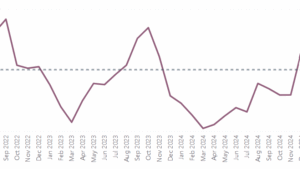 Sep 22 to Dec 24 |
This 3rd crisis was as deep as the initial CoL crisis. Fundraising recovery began in Apr 24 and ran through to Dec 24.
This time, we saw something we hadn't before. Fundraising did not recover to previous levels.
| It appears to have stabilised (far right in the graph), but at a much lower level than before.
What is worrying us is that the current economic conditions appear to be very similar to those in mid 2023 that preceded the last crash. |
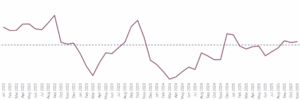 Jan 22 to Nov 25 |
Given we have been unable to recover this time and the potential for a further crash begs the question of whether the sector will reach a tipping point. However, I think that uneven deterioration is more likely than a tipping point that takes down the whole system, thanks to the sector’s diversity, institutional trust, and adaptive capacity. However, we think that we may well see localised tipping points in subsectors and local ecosystems. Larger charities which have contracts with unprotected departments, such as Justice, Education and the Home Office, may be at greatest risk.
Longer term, AI may have an impact too. Either in supporting growing resilience or, less positively, large charities potentially creating digital moats and becoming super dominant to the detriment of medium sized charities.
Demand and Costs. It’s widely anticipated that the Chancellor will scrap the two-child cap on benefit payments, and increase benefits in line with inflation. This will have a significant impact on poverty, particularly children, which is very good news.
Donors. She is also expected to freeze income tax thresholds, which will mean more than 10 million people will be higher-rate taxpayers by the end of the decade, and a tax raid on pension contributions, amongst other tax rises. This will have a negative impact on fundraising, although the extent of this depends on the type and scale of rises (see below).
Public Funding - Departmental Budgets. This may pressure the Chancellor into deeper cuts to unprotected departments such as Justice, the Home Office, local government, housing and parts of education. This is what caused the last collapse in fundraising in late 2023. These reductions are likely to shrink or tighten the grants, commissioning budgets and partnership funding streams that many charities access. On top of this, the FCDO is already undergoing significant reductions because of the fall in the aid budget to 0.3% of GNI, and further cuts are possible.
Public Funding - Bond Markets. Beyond that bond markets are already showing signs of unease. They are likely to react negatively in the short term, unless the Chancellor convinces investors that her welfare expansion is matched by sustainable revenue measures. The credibility of her fiscal plan will determine whether this is temporary or a longer‑term increase in UK debt costs. That would add further pressure to the public finances.
Summary. Overall, the budget is likely to be good news in alleviating poverty and not increasing demand for charity services. However, it will impact charity fundraising through increased taxation on donors and cuts to charity public sector contracts and grants. If bond markets react badly, it will further increase pressure on the public finances, making the situation worse. Whether the economy recovers going forward, or not, will also have a significant impact.
What the Chancellor decides to do in the autumn statement will drive the sector's future in 2026 and she is in a very difficult position. Here's what we think we need to watch out for.
| What Happens | What That Means for Charities | Risk |
| Tax Increases | A negative impact on fundraising income | M |
|
If that's council tax on more expensive properties, the impact would be felt more in London and the Home counties | H |
| Reduction in Benefits | Driving demand for services and increased costs for charities impacted by poverty. Driving overall fundraising competition for everyone. | L |
| Reduce Benefits for Some (eg refugees) | Driving demand for services and increased costs for poverty and refugee charities. | M |
| Departmental Budget Cuts | Almost certainly passed on to charities through cuts in contract funding. More likely to impact larger charities and unprotected budgets such as culture, justice and education. Potentially, further cuts to FCDO budgets? |
H |
| Local Government Funding | Grants to (largely) smaller charities by council are not statutory so more at risk of cuts. | M |
| Fiscal Head Room | The Chancellor might try to hold off by only building a very small fiscal headroom into the budget but that didn't work for her last time and see the next entry below. | L |
| Bond Markets React Badly | If the bond markets don't believe the budget is credible, it will result in higher borrowing rates for a Government already hugely burdened by debt, making the situation worse. | M |
| Staff Costs - NICs | We've seen very significant increases already, the minimum wage will be increased above inflation and the next living wage increase will impact in Apr 26. For charities with large frontline workforces, this compounds NI and pension cost pressures. | H |
A registered charity ourselves, the CEF works for any non profit, not just charities.
Plus, 60+ policies, 8 online health checks and the huge resource base. Quick, simple and very effective.
Find Funding, Free Help & Resources - Everything Is Free.
Thank You! My thanks to Sujith Murughan Mudaliyar who volunteered to build the Power BI dashboards that made this analysis possible and also to the OR Society pro bono team for finding him. Here's the case study.